Oyster, Button, or King Oyster? A Visual Guide to Mushrooms Available in Kigali
Oyster mushrooms: the everyday workhorse
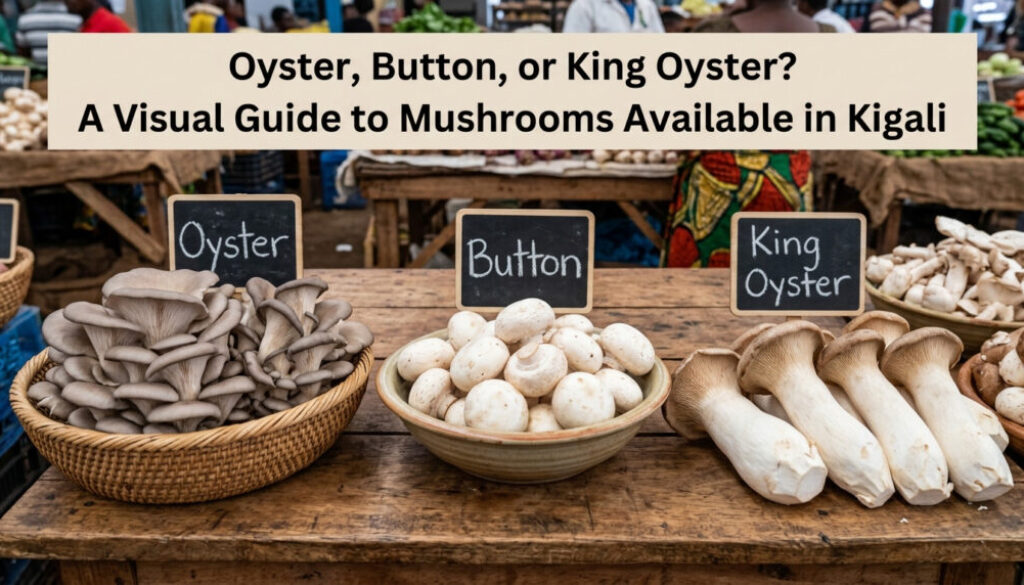
Oyster mushrooms — Pleurotus ostreatus — are the most produced and most consumed cultivated mushroom in the world, and the most common variety in Rwanda. They grow in clusters, with fan-shaped caps ranging from pale grey in cool weather to cream-white in warmer conditions. The underside shows fine white gills that run down to a short, stubby stem.
The flavor is mild with a subtle seafood-adjacent umami. Raw, they smell faintly of anise. Cooked — sautéed in oil with garlic and onion — they develop a deeper savory note and a slightly silky texture. They absorb surrounding flavors without disappearing into them, which makes them ideal for Rwandan cooking, where the sauce carries the dish.
Price in Kigali: 3,000 RWF/kg from Miru Mushrooms. Best for: everyday cooking, stews, sauces, eggs, and any dish calling for a fast, nutritious protein addition.
Button mushrooms: the familiar round ones
Agaricus bisporus — the button mushroom — is what most people picture when they hear the word mushroom. Small, round, cream to white, with a smooth cap and a dense interior. At the button stage, the cap is closed; left to mature, it opens into what is sold as a portobello.
The flavor is more earthy and less delicate than oyster, with a firmer texture that holds up well in slow cooking. Buttons do not collapse in a stew the way oysters might, making them better suited to long-cooked Rwandan dishes.
Slightly less common in Rwanda than oyster varieties and somewhat more expensive. Available occasionally at Kigali specialty markets and through institutional suppliers.
King oyster mushrooms: the premium choice
Pleurotus eryngii — the king oyster — looks almost nothing like its smaller cousin. The cap is small relative to the stem, which is thick, white, and cylindrical. The entire mushroom is dense and meaty, with a texture that genuinely resembles certain seafood or poultry preparations.
Kigali’s better restaurants have discovered king oysters as a meat substitute in dishes where texture matters. Sliced into rounds and pan-seared, they develop a browned, slightly caramelized crust with a tender interior. The flavor is milder than regular oyster mushrooms — almost neutral — making them a vehicle for whatever sauce surrounds them.
More expensive and less widely available than oyster varieties. Best sourced directly from specialty growers or ordered in advance.
Which should you buy for everyday Kigali cooking?
For daily family meals: oyster mushrooms. Fast to cook, nutritionally dense, widely available, and priced for regular purchase at 3,000 RWF/kg. They work in every Rwandan dish without modification.
For special occasions or restaurant use: king oyster when texture matters, button when you need something that holds shape through long cooking.
Order fresh oyster mushrooms from Miru Mushrooms in Kigali: +250-796600706 | www.mirumushrooms.com