
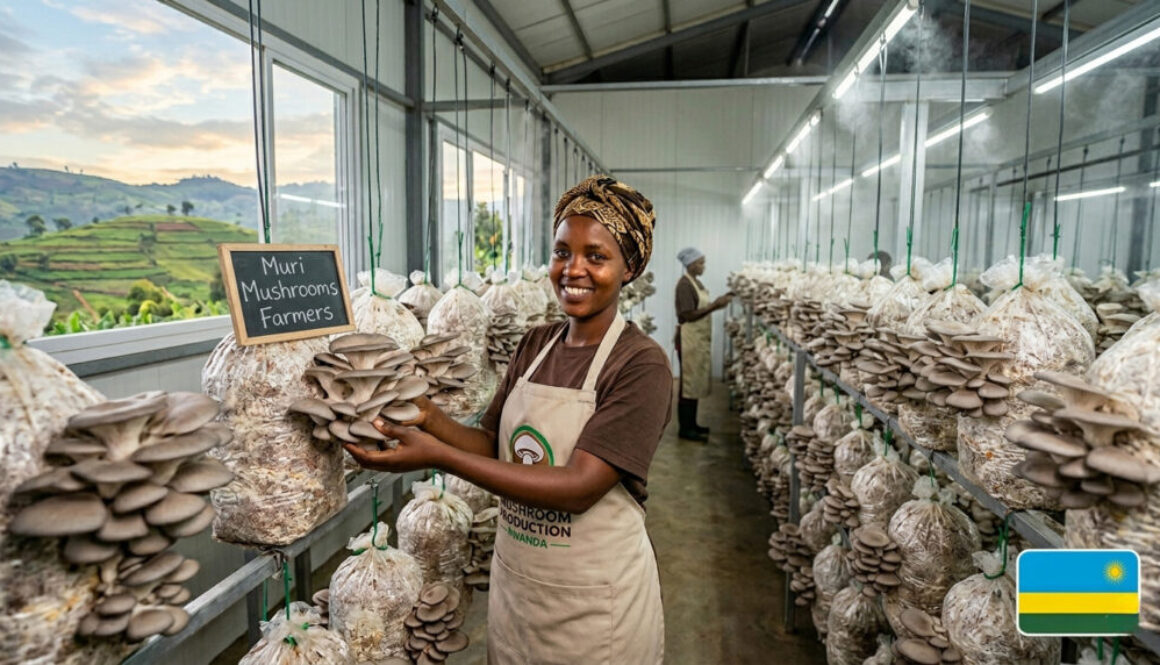
Why Rwanda Is Becoming One of Africa’s Top Mushroom-Producing Countries
The convergence of three factors driving Rwanda’s mushroom rise
Three things rarely arrive together: ideal growing conditions, motivated smallholder farmers, and a developing urban market with rising disposable income. In Rwanda in 2026, all three are present simultaneously, and mushroom production is accelerating as a result.
Kigali’s growing middle class is eating more diversely — seeking protein alternatives, health foods, and restaurant-quality ingredients at home. Rwanda’s rural farmers are looking for crops with short cycles and consistent buyer networks. And the country’s highland climate sits almost exactly in the temperature-humidity range where oyster mushrooms thrive with minimal intervention.
The climate advantage no other East African country fully matches
Mushroom cultivation requires consistent temperatures between 18–28°C for oyster varieties. Rwanda’s highlands, where most smallholder farming occurs, maintain this range across most of the year with no heating or cooling infrastructure required.
Humidity — the other critical variable — naturally averages 70–80% in Rwanda’s agricultural zones. Commercial mushroom facilities in drier countries spend significantly on humidity control that Rwandan farmers get for free.
The result: lower startup costs, fewer failed batches, and faster learning curves for new farmers entering the sector.
The substrate supply chain that makes Rwanda uniquely positioned
Oyster mushrooms grow on agricultural byproducts. Rwanda produces abundant rice straw, maize husks, and sawdust from its timber sector — all effective substrates. This material, often treated as waste, becomes the raw material for a high-value food crop.
For rural farmers, this means the growing medium costs almost nothing. They are transforming zero-value waste into protein-rich food and income. No other short-cycle crop offers this waste-to-value conversion at scale.
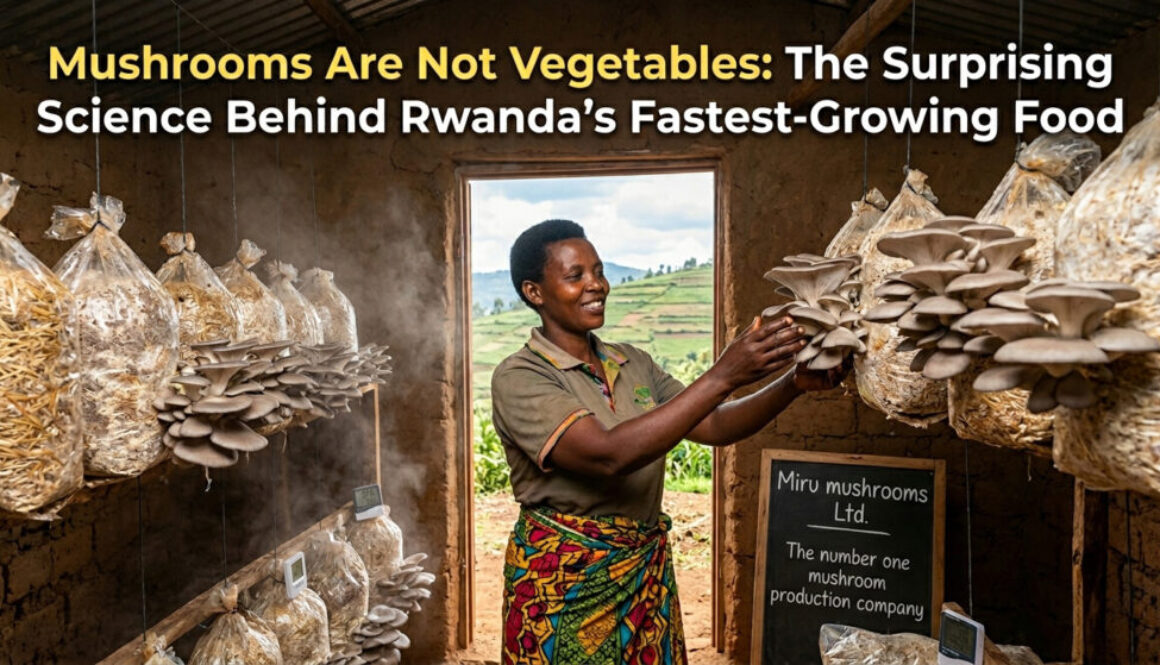
Miru Mushrooms supports farmers in substrate preparation, spawn supply, and market access — removing the three biggest barriers new mushroom farmers face.
Where the market is going: Kigali as the anchor buyer
Kigali is Rwanda’s fastest-growing city and its primary consumption hub. As the city grows, so does demand for fresh, locally-produced food that can be delivered consistently. Mushrooms fit this demand precisely: perishable enough to favor local production over imports, nutritious enough to command a premium, and unfamiliar enough that the first mover who educates the market wins it.
Miru Mushrooms is that first mover. Collection centers in Kigali, a distribution network across the city, and this education campaign are the infrastructure for a market that will grow substantially over the next decade.
|
📍 Buy fresh mushrooms in Kigali · 3,000 RWF/kg · Harvested within 24 hours 📞 +250-796600706 · 📧 mirumushrooms@gmail.com · 🌐 www.mirumushrooms.com |