Mushrooms Are Not Vegetables: The Surprising Science Behind Rwanda’s Fastest-Growing Food
The kingdom of fungi — Rwanda’s misunderstood food group
When Rwandan families categorize their food, they think in familiar terms: grains, legumes, vegetables, and meat. Mushrooms fall through every category. They are not plants — they have no chlorophyll, no roots, no leaves, and they make no use of sunlight. They are not animals — they cannot move or consume other organisms whole. They are fungi: a kingdom so distinct from plants that scientists estimate fungi are genetically closer to animals than to vegetables.
This is not a minor biological footnote. It fundamentally changes how we should think about mushrooms as food. When a plant grows, it draws minerals from the soil and converts sunlight into carbohydrates. When a fungus grows, it breaks down complex organic matter — straw, wood, agricultural waste — and concentrates what it finds. The nutritional profile that results is unlike anything in the plant kingdom.
What happens nutritionally when fungi break down substrate
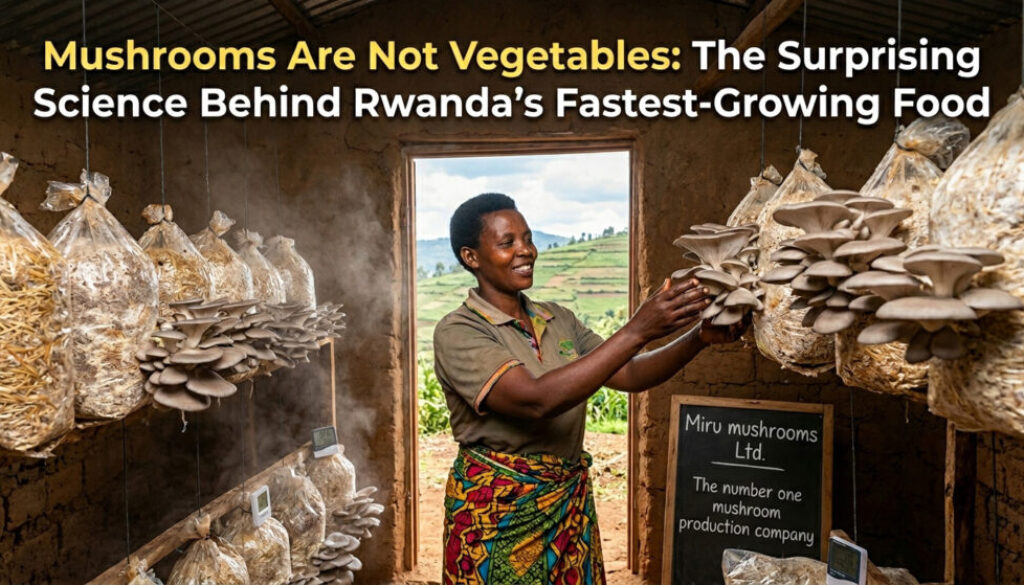
Oyster mushrooms grown on rice straw are essentially transforming low-value agricultural waste into high-value protein. The mycelium — the thread-like body of the fungus — secretes enzymes that dissolve lignin and cellulose, absorbing the broken-down compounds and reassembling them into fungal tissue.
That fungal tissue contains: complete protein with all eight essential amino acids (rare in plant foods), beta-glucans (complex sugars that activate immune cells), ergosterol (a compound that converts to vitamin D when exposed to sunlight), and B vitamins, including riboflavin, niacin, and pantothenic acid, that are almost entirely absent from staple Rwandan grains.
None of this happens in a vegetable. It is a fundamentally different nutritional process, producing a fundamentally different food.
Why are these matters important for Rwandan family nutrition?
Rwanda’s staple diet — heavy on rice, cassava, beans, and plantain — is calorically sufficient but nutritionally incomplete. The missing elements are precisely what mushrooms provide: B vitamins, complete amino acids, and immune-activating compounds.
This is not speculation. It is the reason international nutrition programs in sub-Saharan Africa increasingly focus on mushrooms as a low-cost intervention for diet quality. In Rwanda specifically, where the rural diet often lacks variety, the addition of 100g of oyster mushrooms to a daily meal changes the nutritional calculus significantly.
At 3,000 RWF per kilogram from Miru Mushrooms in Kigali, that change costs roughly 300 RWF per serving. Less than a phone top-up. More nutritional impact than most supplements.
Ordering in Kigali
Miru Mushrooms delivers fresh oyster mushrooms across Kigali. WhatsApp: +250-796600706. Collection centers open daily. Bulk orders for institutions are welcome.