How Mushrooms Grow: From Spore to Your Plate in 45 Days — Rwanda’s Fastest Crop
Day 0: The substrate bags are prepared
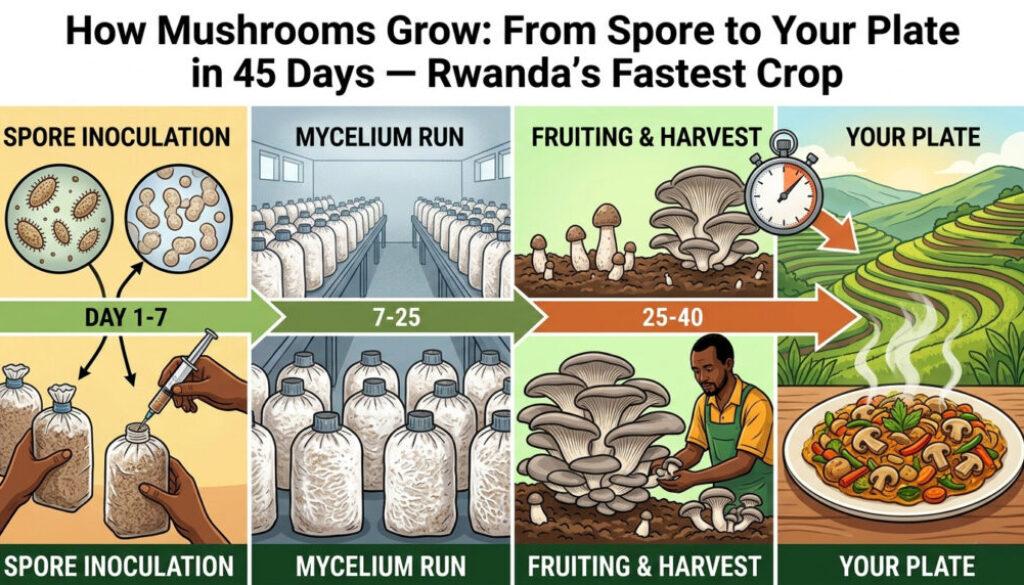
Every batch of mushrooms begins not with soil but with substrate: agricultural byproduct material that the fungus will colonize and consume. On Rwandan farms working with Miru Mushrooms, this substrate is typically rice straw or sawdust mixed with a small amount of bran for extra nutrition.
The substrate is packed tightly into plastic bags and sterilized — either by steam or through a lime-water pasteurization process — to kill competing organisms that might prevent the mushroom spawn from establishing itself. This step is critical. A contaminated bag will grow mold or bacteria before the mushroom mycelium can take hold.
Day 1–2: Spawn inoculation
Mushroom spawn — grain or sawdust colonized with mushroom mycelium — is mixed into the sterilized substrate and the bags are sealed. This must happen quickly, in conditions as clean as possible, to prevent airborne contamination from undoing the sterilization.
The bags are then moved to the growing room: typically a small structure with controlled temperature, some ventilation, and shade. Direct sunlight is the enemy — it dries the surface and raises temperature beyond the ideal 20–28°C range for oyster mushroom development.
Days 3–33: The colonization phase
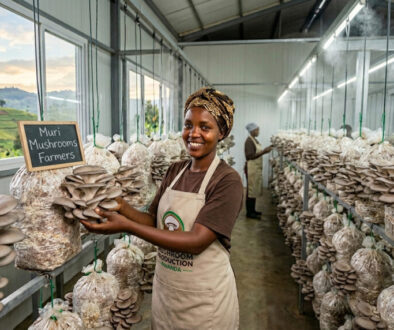
Over the next week, white thread-like mycelium spreads through the bag. Starting from each inoculation point, the threads branch and spread until they meet, eventually covering the entire substrate mass in a dense white network.
This is the quiet phase. Nothing to harvest. Nothing to see from outside. But inside the bag, the fungus is restructuring the substrate completely, breaking down the cellulose and lignin and building fungal biomass in its place. The bag becomes warm to the touch — metabolic heat from active mycelial growth.
Farmers check for contamination: any green, black, or orange patches indicate a competing mold and the bag should be removed before it spreads.
Days 33–45: Pinning and fruiting
When the substrate is fully colonized, farmers make small cuts or holes in the plastic. This triggers the fungus to shift from vegetative growth to reproduction — it senses the atmospheric CO2 drop and light change through the openings and begins forming primordia: tiny pin-headed mushroom buds.
Over the next four to six days, these pins swell rapidly into full mushrooms. The growth is visibly fast — a pin the size of a match head on Monday can be harvest-ready by Friday. The caps expand, the clusters fill in, and the mushrooms are ready when the cap edges are still slightly curled under — before they flatten out and begin dropping spores.
Harvest is by hand: a gentle twist-and-pull that removes the cluster cleanly. The substrate bag can produce two to three more flushes before its nutrients are exhausted — each flush taking 10–14 days.
From farm to Kigali within 24 hours
Miru Mushrooms coordinates harvest and delivery so that mushrooms reach Kigali collection centers within 24 hours of picking. At that freshness level, they will hold for 5–7 days in a refrigerator paper bag. Order: +250-796600706 | www.mirumushrooms.com