
Everything You Need to Know About Mushrooms: A Complete Guide for Rwandans in Kigali
What mushrooms actually are — and why most Rwandans have it wrong?
Call them a vegetable and any mycologist will correct you. Mushrooms belong to the fungi kingdom — a biological category entirely separate from plants and animals. They produce no chlorophyll. They need no sunlight. They grow not from seeds but from microscopic spores, and they consume organic matter rather than convert sunlight into food.
This distinction matters because it explains everything about their nutrition. Without photosynthesis, mushrooms build their energy from substrate — typically agricultural byproducts like rice straw, sawdust, or maize husks. That process concentrates nutrients in ways plants cannot replicate. The result: a food with the amino acid profile of meat, the fiber profile of vegetables, and the vitamin complexity of a supplement.
In Kigali’s markets, mushrooms are sometimes shelved next to onions and tomatoes. That placement is wrong, but the proximity to your cooking is exactly right.
The three types of mushrooms you will find in Rwanda
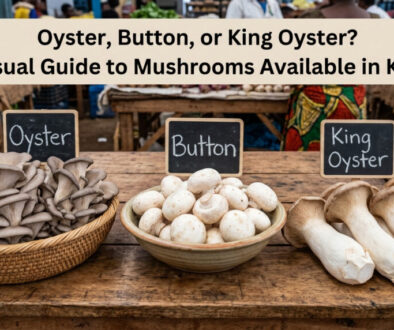
Oyster mushrooms are the most widely grown and most affordable variety in Rwanda. Their caps are fan-shaped, ranging from pale grey to cream, with gills running down a short off-center stem. The flavor is mild — slightly savory, faintly earthy — and they absorb whatever you cook them with, making them ideal for Rwandan dishes already built on aromatics.
Button mushrooms are the round, white variety familiar from global cuisines. Denser than oysters, they hold their shape well in slow-cooked dishes. Slightly more expensive and less locally abundant.
King Oyster mushrooms — also called Pleurotus eryngii — are large, meaty, and increasingly sought by Kigali restaurants. Their thick stems have a texture that genuinely substitutes for certain meat preparations. They cost more, but the yield per kilogram of food is exceptional.
Miru Mushrooms focuses on oyster varieties, farmed at scale across Rwanda and delivered fresh to Kigali collection centers within 24 hours of harvest.
How are mushrooms currently grown across Rwanda?
A mushroom farm needs no soil. That is the first surprise for most visitors. The growing medium — called substrate — is sterilized rice straw or sawdust packed into plastic bags. These bags are inoculated with mushroom spawn: the fungal equivalent of seed. Within days, white mycelium threads colonize the bag completely. Within two weeks, fruiting bodies push through small cuts in the plastic.
Rwanda’s highlands offer near-ideal mushroom growing conditions. Cool nights slow contamination. Moderate humidity keeps mushrooms plump. Clean air matters less than temperature control, and the country’s altitude naturally provides it.
A small room — three meters by four — can hold enough substrate bags to produce commercial quantities weekly. This is why mushroom farming has expanded so quickly among smallholder farmers in districts around Kigali. The startup cost is low, the cycle is fast, and the market — once educated — is ready to absorb the supply.
Where to find fresh mushrooms in Kigali today?
Miru Mushrooms operates collection centers across Kigali, stocked with fresh oyster mushrooms harvested within the previous 24 hours. Price: 3,000 RWF per kilogram. Delivery is available for orders placed via WhatsApp.
For families, schools, restaurants, and hospitals purchasing in volume, the team offers scheduling and bulk pricing. The consistency of supply — something that historically made mushrooms unreliable in Kigali markets — is now managed across the entire Miru farmer network.
Contact: +250-789049208 | mirumushrooms@gmail.com | www.mirumushrooms.com